You notice more scalp showing through your part, your ponytail feels thinner, or you can see your scalp under bright lights. Thinning hair is upsetting, but it’s very common in women, and there are treatments that can help hair grow back thicker.
This guide explains why women get thinning hair, how to tell the main types apart, and the treatments with the best evidence. For hair that’s falling out suddenly, read our guide to hair loss in women. Here is what causes thinning hair and the treatments that work.
Key takeaways
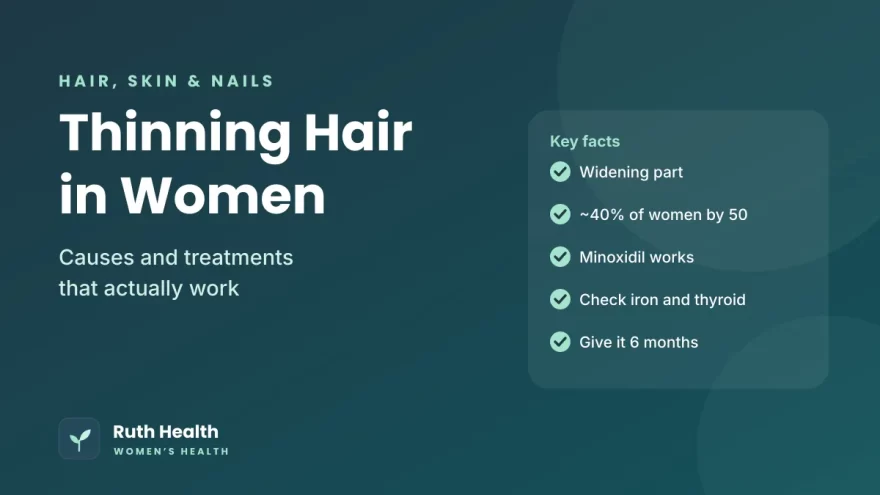
- The most common cause of thinning hair in women is female pattern hair loss, which causes a widening part and thinning on top of the scalp.
- It’s common: about 40% of women show signs by age 50.
- Minoxidil is the main FDA-approved treatment for female pattern hair loss, and 5% foam once daily helps regrow hair.
- Other causes include shedding after stress or illness, low iron, thyroid problems, PCOS and tight hairstyles.
- Treatment takes at least 3 to 6 months to show results, so patience is key.
What causes thinning hair in women?
Female pattern hair loss
Female pattern hair loss (FPHL) is the most common cause of thinning hair in women. A review notes that fewer than 45% of women go through life with a full head of hair, and prevalence rises from about 12% in women in their 20s to over 50% of women over 80.
FPHL causes generalized thinning of hair and widening of the scalp parting. Unlike men, women rarely go bald; the hairline at the front usually stays in place. It runs in families and is more common after menopause. The Australasian College of Dermatologists says around 40% of women show signs of FPHL by age 50.
Telogen effluvium (shedding)
A shock to the body, such as childbirth, illness, high fever, surgery, crash dieting or severe stress, can push many hairs into the shedding phase at once. Hair falls out 2 to 3 months later and usually regrows within 6 to 12 months.
Low iron
Low iron stores are linked to hair shedding. See low iron symptoms in women.
Thyroid problems
Both under- and overactive thyroid can cause thinning hair. See hypothyroidism symptoms.
PCOS and high androgens
Women with PCOS may have thinning on the top of the head along with acne and excess facial hair. See PCOS symptoms.
Menopause
Falling estrogen can make hair finer and thinner.
Tight hairstyles
Tight ponytails, braids, weaves and extensions can cause traction alopecia, often around the hairline.
Signs of female pattern hair loss
- A wider part than before.
- Thinning on the top and crown of the head.
- Hair that’s finer and shorter than it used to be.
- A smaller ponytail.
- The front hairline usually stays in place.
Treatments that work
Minoxidil
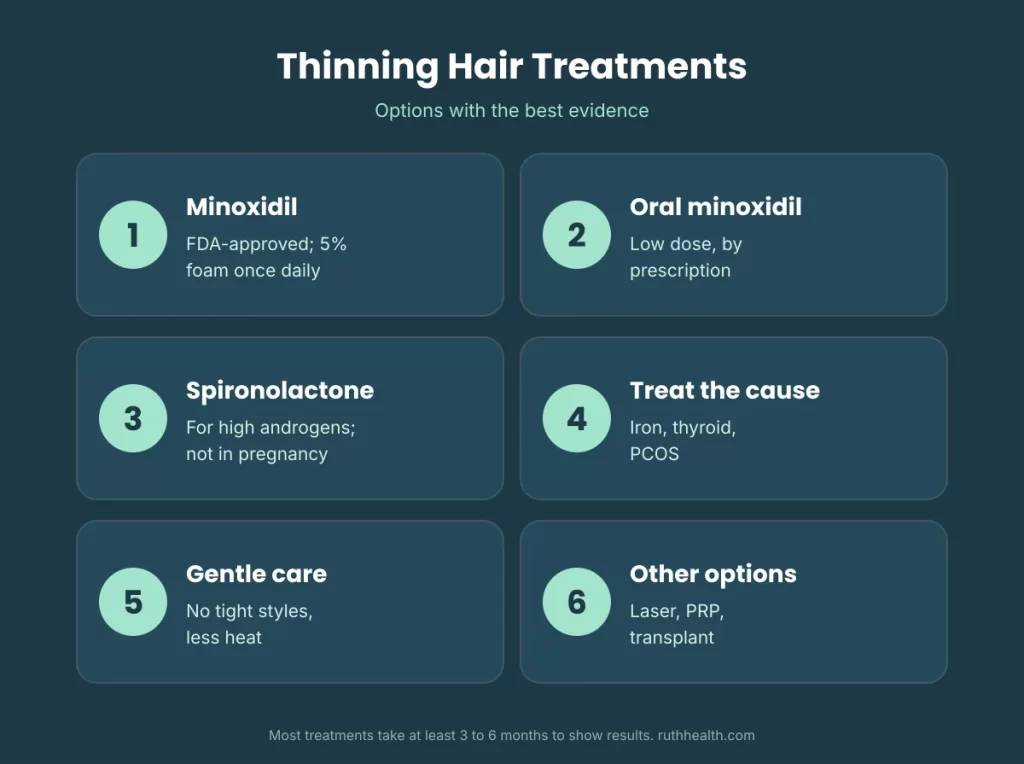
Minoxidil is the main FDA-approved treatment for female pattern hair loss. It’s available over the counter as a 2% solution and a 5% foam. A review notes that the FDA approved 5% minoxidil foam for female pattern hair loss in 2014.
In a phase III trial of 404 women, once-daily 5% foam for 24 weeks promoted hair regrowth and improved scalp coverage and hair density compared with a placebo foam.
Tips for using minoxidil:
- Apply to a dry scalp, usually once (foam) or twice (solution) a day.
- Expect some extra shedding in the first few weeks; this is normal.
- Give it at least 6 months to judge results.
- Keep using it: hair gained will be lost if you stop.
- Don’t use it during pregnancy or breastfeeding.
Low-dose oral minoxidil
Some dermatologists prescribe low-dose minoxidil tablets off-label. This needs a prescription and medical monitoring.
Spironolactone
This anti-androgen tablet may help women with female pattern hair loss, especially those with signs of high androgens. It’s not safe in pregnancy.
Treating the cause
If thinning is due to low iron, thyroid disease or another condition, treating that can allow hair to regrow.
Other options
- Low-level laser therapy devices.
- Platelet-rich plasma (PRP) injections.
- Hair transplant for some women with stable thinning.
- Cosmetic options such as volumizing products, fibers and hairpieces.
Daily habits to protect your hair
- Avoid tight hairstyles and heavy extensions.
- Use a wide-tooth comb and be gentle with wet hair.
- Limit heat styling and harsh chemical treatments.
- Eat enough protein, iron and overall calories.
- Manage stress and sleep well.
Do hair supplements work?
Biotin, collagen and “hair, skin and nails” supplements are hugely popular. Unless you’re deficient, there’s little evidence they help female pattern hair loss, and biotin can interfere with blood tests. Read about collagen for skin. Compare products in our hair and skin supplement reviews, scored with our 11-point audit.
When to see a doctor
- Hair loss is sudden or in patches.
- Your scalp is itchy, painful, red or scaly.
- You also have irregular periods, acne or excess facial hair.
- You feel tired, cold or have other symptoms of thyroid problems or anemia.
- Over-the-counter treatment hasn’t helped after 6 months.
A dermatologist can confirm the cause and may suggest blood tests for iron, thyroid and hormones.
Frequently asked questions about thinning hair
Can thinning hair grow back?
Often, yes. Shedding from stress or illness usually regrows on its own. Female pattern hair loss can improve with minoxidil, though early treatment works best.
What is the best treatment for thinning hair in women?
Minoxidil is the best-studied, FDA-approved treatment for female pattern hair loss.
Why is my hair thinning at the crown?
Thinning at the crown and a widening part are typical of female pattern hair loss.
Does menopause cause thinning hair?
Yes. Falling estrogen can make hair finer, and female pattern hair loss is more common after menopause.
How long does minoxidil take to work for women?
Most women need at least 3 to 6 months of daily use to see results.
The bottom line on thinning hair
Thinning hair in women is most often caused by female pattern hair loss, which affects about 40% of women by age 50. Minoxidil is the best-proven treatment and can regrow hair with consistent use. Rule out low iron, thyroid problems and PCOS, be gentle with your hair, and see a dermatologist if thinning is sudden, patchy or not improving.