
Collagen powders, gummies and drinks promise firmer, smoother, younger-looking skin. Collagen has become one of the best-selling supplements for women, but do these products actually work, or are you just paying for expensive protein?
This guide looks at what the research shows, how collagen supplements might work, who benefits most, how to choose a product, and what else helps your skin’s collagen. This guide explains everything you need to know about collagen for skin.
Key takeaways
- Collagen makes up about 80% of the dry weight of your skin, and production falls with age, sun exposure and menopause.
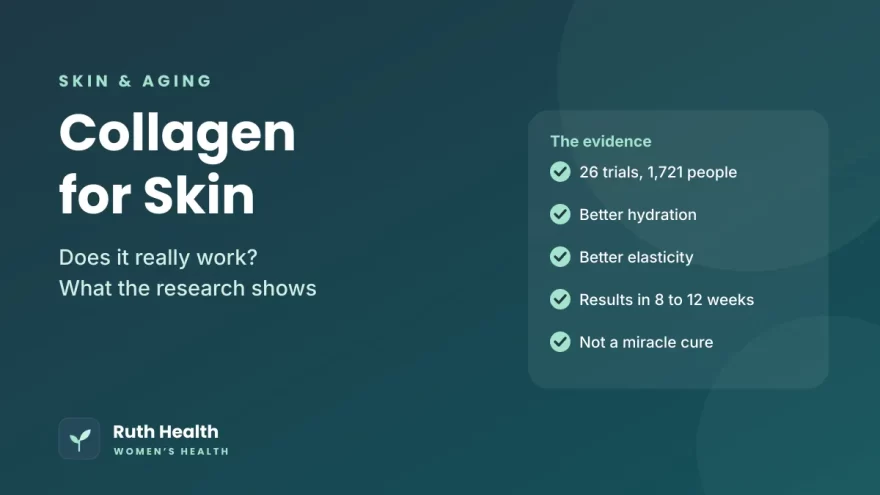
- A 2023 meta-analysis of 26 randomized trials with 1,721 people found hydrolyzed collagen significantly improved skin hydration and elasticity compared with placebo.
- Benefits usually appear after 8 to 12 weeks of daily use.
- Many studies are small and some are industry-funded, so results should be viewed with some caution.
- Sunscreen, retinoids, not smoking and a protein-rich diet remain the foundations of healthy skin.
What is collagen and why does it matter for skin?
Collagen is the most abundant protein in your body, and it makes up about 80% of the dry weight of human skin. Together with elastin and hyaluronic acid, it gives skin its structure, firmness and bounce.
With age, your body makes less collagen. Sun exposure, smoking, high sugar intake and the drop in estrogen at menopause speed up the loss. Skin becomes thinner, drier and less elastic, and wrinkles form.
How do collagen supplements work?
Most supplements contain hydrolyzed collagen (collagen peptides), which is broken down into small pieces that are easier to absorb. According to a 2023 review, hydrolyzed collagen is rich in amino acids like hydroxyproline, proline and glycine, which are absorbed as small peptides and transported to the skin.
These peptides are thought to signal skin cells (fibroblasts) to make more collagen, rather than simply being “added” to your skin.
Does collagen actually work for skin?
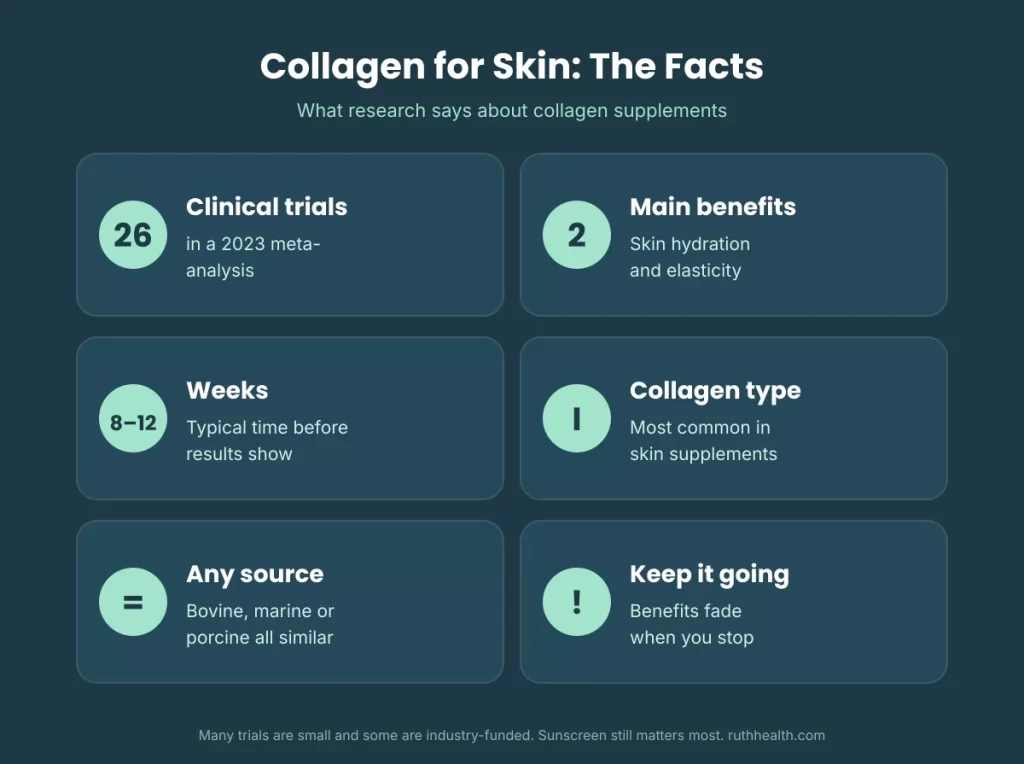
The evidence is promising. A 2023 systematic review and meta-analysis in Nutrients included 26 randomized controlled trials with 1,721 participants. It found that hydrolyzed collagen significantly improved skin hydration and elasticity compared with placebo.
A second meta-analysis of 14 studies with 967 participants also found consistent improvements in skin moisture and elasticity.
The caveats:
- Many trials are small and short.
- The Nutrients review identified several biases in the included trials and called for larger studies.
- Some studies are funded by supplement makers.
- Results vary by product, dose and duration.
So collagen may help skin hydration and elasticity, but it isn’t a miracle anti-aging cure.
How long does collagen take to work?
Most studies show improvements after 8 to 12 weeks of daily use. Benefits fade if you stop.
Collagen types and sources
| Type | Found in | Main role |
|---|---|---|
| Type I | Skin, bones, tendons | Skin firmness and structure (most common in skin supplements) |
| Type II | Cartilage | Joint support |
| Type III | Skin, blood vessels | Often found with type I |
Supplements come from bovine (cow), marine (fish) or porcine (pig) sources. The Nutrients meta-analysis found no significant differences in skin elasticity between sources.
How to choose a collagen supplement
- Hydrolyzed collagen or collagen peptides for better absorption.
- Dose: most skin studies use about 2.5 to 10 grams a day.
- Third-party tested for purity and heavy metals.
- Minimal added sugar (watch out for gummies).
- Check the source if you avoid certain animal products. Collagen is never vegan; “vegan collagen boosters” contain nutrients that support your own collagen instead.
See our hair and skin supplement reviews, scored with our 11-point audit.
Is collagen safe?
Collagen is generally well tolerated. Possible side effects include mild stomach upset, bloating or a lingering taste. People with fish or egg allergies should check the source. Collagen is a protein, so if you have kidney disease or are on a protein-restricted diet, check with your doctor.
Other ways to boost your skin’s collagen
These have the strongest evidence for protecting collagen:
1. Wear sunscreen daily (SPF 30 or higher). UV light is the biggest cause of collagen breakdown.
2. Use a retinoid (retinol or prescription tretinoin), which is proven to boost collagen production.
3. Don’t smoke. Smoking damages collagen and speeds up wrinkles.
4. Eat enough protein to provide the building blocks for collagen.
5. Get vitamin C from fruit and vegetables; it’s essential for collagen production.
6. Limit added sugar, which can damage collagen through a process called glycation.
7. Sleep well and manage stress.
Collagen during menopause
Skin loses collagen quickly in the first years after menopause as estrogen falls. Many women notice drier, thinner skin. Collagen supplements, sunscreen, retinoids and moisturizers may help. Read about menopause weight gain and other changes in our menopause guides.
Comparing skin supplements? Our Celluvia review looks at a popular skin capsule that contains vitamins and botanicals but no collagen.
Frequently asked questions about collagen for skin
Does collagen really work for wrinkles?
Studies show improvements in skin hydration and elasticity, and some show reduced wrinkle depth, but results are modest and vary between products.
When is the best time to take collagen?
There’s no proven best time. Take it consistently every day, in a drink, smoothie or food.
Can collagen help hair and nails?
Some small studies suggest benefits for nails, but evidence for hair is limited. Read about brittle nails and hair loss in women.
Is it better to get collagen from food?
Bone broth, fish skin and gelatin contain collagen, but amounts vary. Eating enough protein and vitamin C helps your body make its own.
Can you take too much collagen?
Collagen is generally safe at typical doses. Very high intakes add extra protein, which most healthy people tolerate.
The bottom line on collagen for skin
Collagen supplements, especially hydrolyzed collagen peptides, may improve skin hydration and elasticity after 8 to 12 weeks, according to meta-analyses of randomized trials. But the studies have limitations, and supplements work best alongside the proven basics: daily sunscreen, retinoids, not smoking, and a diet rich in protein and vitamin C.
Read more in our skin and aging guides.
