
Celluvia is sold as an “Advanced Skin Rejuvenation Formula”: a daily capsule to support collagen, firmness and a more radiant complexion. With skin changing fast in your 40s and 50s, that’s an appealing promise. But what’s actually in the capsule, and is it worth around $50 to $80 a bottle? This Celluvia review breaks down the label, the science behind each ingredient, and what dermatologists say really works for aging skin.
*Disclosure: Ruth Health may earn a commission if you buy through links on this page. It doesn’t change our verdict, and we never accept payment for a positive review. See our review methodology.* Here is our full Celluvia review, based on the label and the research.
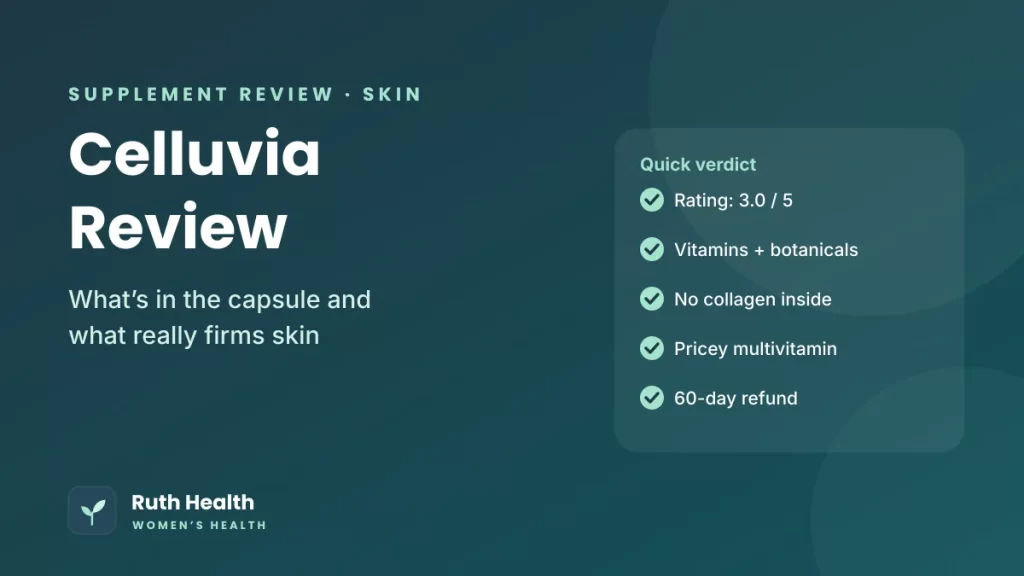
Celluvia review: quick verdict
- What it is: a once-daily capsule with vitamins, minerals and a botanical blend, marketed for skin.
- What’s missing: no collagen peptides, no hyaluronic acid, and no published amounts for the botanical blend.
- Best for: women who want a skin-focused multivitamin and don’t already take one.
- Not for: anyone pregnant or breastfeeding, anyone with a soy allergy, or anyone already taking a multivitamin or iron.
- Price: $49 to $79 a bottle depending on package. 60-day money-back guarantee.
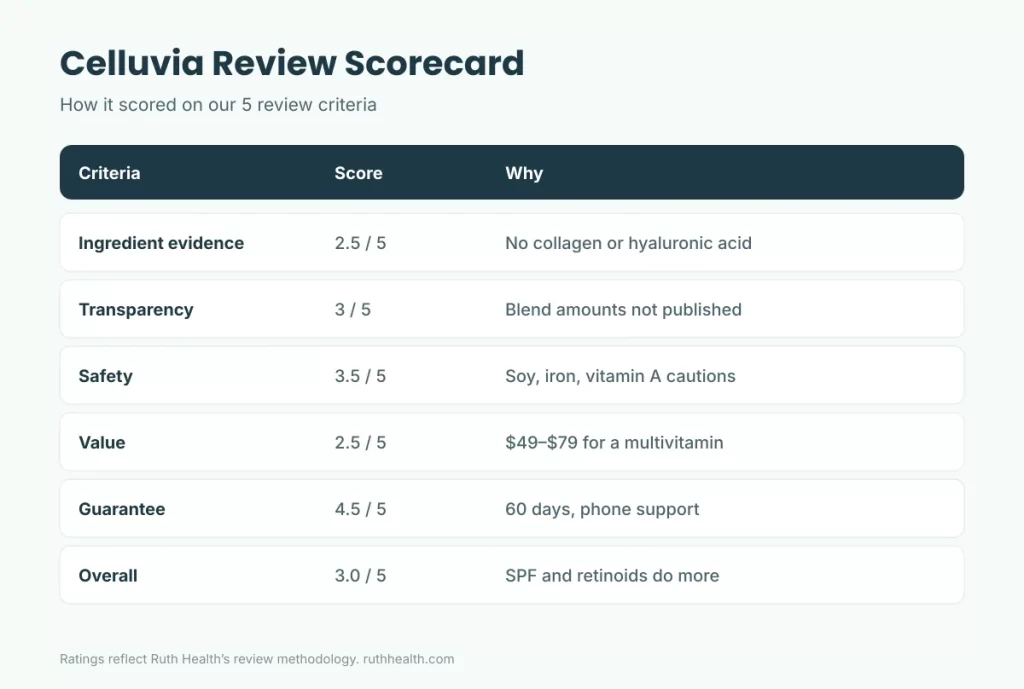
- Our rating: 3.0 / 5. Essentially a premium multivitamin with botanicals. Sunscreen and a retinoid will do more for your skin.
What is Celluvia?
Celluvia is a dietary supplement in capsule form. Its maker markets it as an “Advanced Skin Rejuvenation Formula” that supports collagen and skin elasticity, the look of fine lines, and radiance. The label calls for one capsule a day, says not to exceed that dose, and lists soy as an ingredient.
The official order page offers 2-, 3- and 6-bottle packages, a 60-day money-back guarantee, and a US order-status phone line, with orders fulfilled from Utah.
Celluvia ingredients
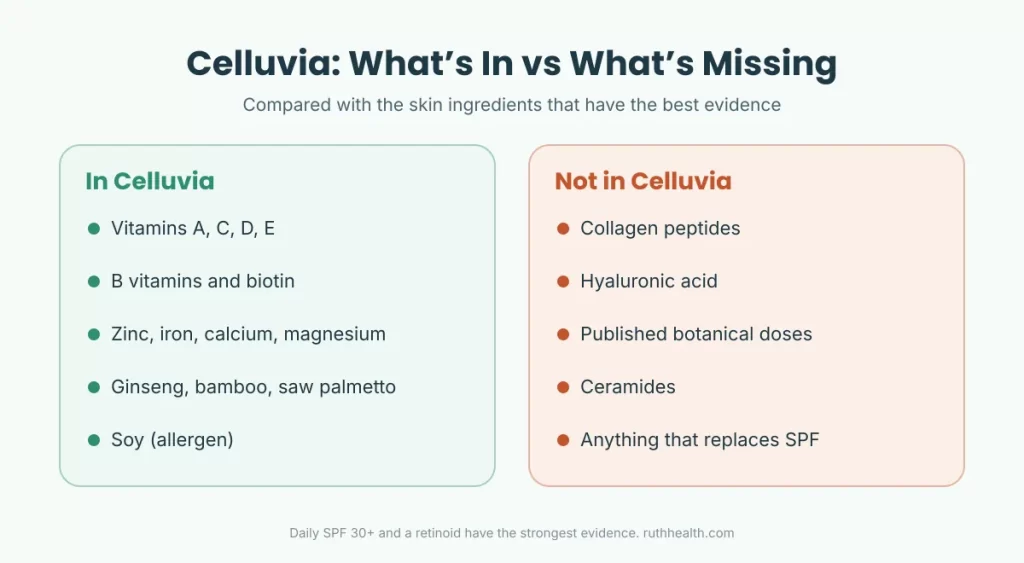
According to published label summaries, Celluvia contains vitamins A, C, D and E, several B vitamins, biotin and minerals such as calcium, iron, magnesium and zinc, plus a botanical blend of Panax ginseng, spirulina, bamboo extract, stinging nettle, Chinese peony, saw palmetto, alfalfa and barley grass. PABA and L-theanine are also included. The other ingredients are rice flour, hypromellose, vegetable magnesium stearate and silicon dioxide.
Individual amounts for the blend aren’t published, so we can’t compare doses with research.
Vitamin C
Your body needs vitamin C to build collagen, and it’s an antioxidant. But true deficiency is rare if you eat fruit and vegetables, and extra oral vitamin C hasn’t been shown to reverse wrinkles. Topical vitamin C serum has stronger evidence for brightening skin.
Vitamin E, A and zinc
All support normal skin, but again mainly matter if you’re low in them.
Biotin
Biotin is in almost every “hair, skin and nails” product. Deficiency causes skin rashes, but extra biotin hasn’t been shown to improve healthy skin. High doses can also interfere with lab tests, including thyroid and heart tests. Tell your doctor you take it.
Botanical blend
- Bamboo extract is a source of silica, often marketed for skin, hair and nails, with limited human research.
- Panax ginseng has a few small studies on skin wrinkles, mostly in topical form.
- Saw palmetto may block some effects of androgen hormones. It’s studied mainly for prostate and hair, not skin aging, and it isn’t advised in pregnancy.
- Spirulina, nettle, alfalfa, barley grass and Chinese peony add antioxidants and nutrients, but there’s little evidence for skin aging at supplement doses.
What’s missing
The supplement ingredients with the best evidence for skin are hydrolyzed collagen peptides, which some studies link to modest improvements in skin hydration and elasticity, and hyaluronic acid. Celluvia contains neither. Read our review of collagen for skin for the evidence.
Does Celluvia work?
There are no published trials of Celluvia itself. Based on its ingredients:
- If you’re low in vitamins or minerals, a daily multivitamin like this may help your skin look healthier.
- If you already eat well or take a multivitamin, it’s unlikely to make a visible difference to wrinkles or firmness.
- Without published amounts, we can’t tell whether the botanicals reach useful doses.
Most of what ages skin, especially after menopause, comes from collagen loss as estrogen falls, and from sun damage. The treatments with the strongest evidence are daily SPF 30+, a retinoid, and a good moisturizer.
Celluvia review: pros and cons
Pros
- One capsule a day
- Covers a broad range of vitamins and minerals linked to normal skin
- 60-day money-back guarantee with a phone number to call
- Ingredient list available
Cons
- No collagen peptides or hyaluronic acid
- Botanical amounts not disclosed
- Pricey for what is largely a multivitamin
- Contains iron and vitamin A, so doubling up with another multivitamin could mean too much
- Contains soy
Celluvia review: who should skip it?
Avoid Celluvia, or check with your doctor first, if you:
- Are pregnant, breastfeeding or trying to conceive (vitamin A, saw palmetto, ginseng)
- Already take a multivitamin or iron supplement
- Have hemochromatosis (iron overload)
- Have a soy allergy
- Take blood thinners (vitamin E, ginseng)
- Are having blood tests soon (biotin can skew results)
- Are under 18
Celluvia review: price and guarantee
According to the official order page:
| Package | Total | Per bottle | Shipping |
|---|---|---|---|
| 2 bottles (60 days) | $158 | $79 | Paid |
| 3 bottles (90 days) | $216 | $72 | Free (US) |
| 6 bottles (180 days) | $294 | $49 | Free |
Every order is covered by a 60-day money-back guarantee.
Our advice: if you want to try it, the 2-bottle package gives you 60 days, matching the refund window. Take photos in the same light before you start and after 8 weeks so you can judge honestly.
Check the current Celluvia price on the official website
What really works for aging skin
If your goal is firmer, smoother skin, these have far stronger evidence than any capsule:
1. Daily broad-spectrum SPF 30+, which prevents further collagen breakdown and dark spots.
2. A retinoid (retinol or prescription tretinoin), which boosts collagen and smooths fine lines.
3. A moisturizer with hyaluronic acid, glycerin or ceramides.
4. Not smoking, which speeds up collagen loss.
5. Enough protein and plenty of fruit and vegetables.
6. Talking to your doctor about hormone therapy if menopause symptoms are part of the picture.
Frequently asked questions about celluvia review
What is Celluvia used for?
It’s marketed to support collagen, skin elasticity, fine lines and radiance. It’s a dietary supplement, not a medicine.
What are the Celluvia ingredients?
Vitamins A, C, D and E, B vitamins, biotin, calcium, iron, magnesium and zinc, plus a botanical blend including ginseng, spirulina, bamboo extract, nettle, Chinese peony and saw palmetto. It also contains PABA, L-theanine and soy.
Does Celluvia contain collagen?
No. It contains vitamin C, which your body uses to make collagen, but no collagen peptides.
Does Celluvia have side effects?
Possible side effects include stomach upset. It contains soy, iron and vitamin A, so check with your doctor if you take other supplements or are pregnant.
Is Celluvia legit?
It’s a real product with a 60-day money-back guarantee and a US phone line. “Legit” doesn’t mean proven, though: there are no published trials of Celluvia itself.
The bottom line on celluvia review
Our Celluvia review finds a well-rounded skin-focused multivitamin with a botanical blend, but no collagen, no hyaluronic acid and no published botanical doses. It may help if your diet is lacking, but it’s unlikely to visibly firm or smooth healthy skin. For real results, put your money into daily sunscreen and a retinoid first. If you still want to try Celluvia, start with the 2-bottle package and use the 60-day guarantee if you don’t see a difference.
