
If the number on your scale started creeping up in your mid-to-late 40s, even though you’re eating the same way you always have, you’re not imagining it, and you’re not alone. Weight gain is one of the most common changes women notice during perimenopause and the years right after their final period. This guide explains everything you need to know about menopause weight gain.
The good news is that this weight gain follows a predictable pattern, the causes are well studied, and most of them respond to specific, practical changes. This guide explains exactly what happens to your body, how much weight gain is typical, why it settles around your middle, and the steps with the strongest evidence for stopping it.
Key takeaways
- Women gain about 1.5 pounds (0.7 kg) a year on average through their 50s, and the change often starts in perimenopause.
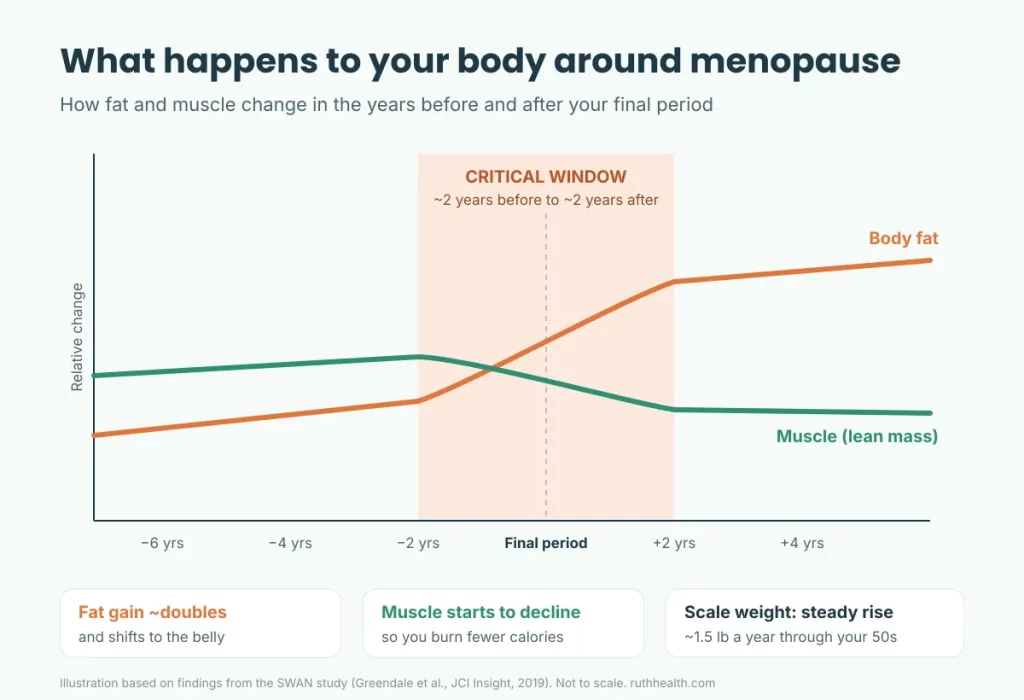
- Research from the SWAN study shows that fat gain roughly doubles and muscle starts to decline about 2 years before your final period, continuing until about 2 years after it.
- Falling estrogen shifts fat storage from the hips and thighs to the belly, even when total weight barely changes.
- Muscle loss, poor sleep from night sweats, appetite changes, stress, and less daily movement all add to the problem.
- Strength training, enough protein, better sleep and fewer liquid calories are the most effective tools. Hormone therapy treats symptoms but is not a weight-loss treatment.
How much weight do women gain during menopause?
According to Mayo Clinic, weight gain often begins a few years before menopause and continues at roughly 1.5 pounds (0.7 kg) a year as women move through their 50s. A 2022 review of midlife weight gain found the same average of about 1.5 pounds a year between ages 50 and 60, regardless of starting body size or race.
That may not sound like much, but it adds up. Over a 10-year menopause transition it can mean 10 to 15 extra pounds, and much of it lands around the waist.
It’s also worth knowing that not every woman gains weight. Researchers at Brigham and Women’s Hospital have pointed out that every woman loses estrogen at menopause, yet only about half gain significant weight (Endocrine Society). That tells us other factors, many of them within your control, make a big difference.
When does menopause weight gain start and stop?
The most detailed answer comes from the Study of Women’s Health Across the Nation (SWAN), which tracked the same women with body scans for more than a decade. Published in JCI Insight in 2019, it found that:
- Before the transition, both fat and muscle increased slowly.
- About 2 years before the final menstrual period, the rate of fat gain doubled and lean (muscle) mass began to decline.
- These changes continued until about 2 years after the final period, then levelled off.
One surprising finding: the scale didn’t show a sudden jump. Total weight kept climbing at a steady rate because the extra fat was partly offset by lost muscle. In other words, your body composition can change a lot even when your weight changes only a little. That’s why many women say their clothes fit differently before the scale moves.
| Stage | Typical age | What happens to your body |
|---|---|---|
| Premenopause | 30s to early 40s | Slow, steady gain in both fat and muscle |
| Early perimenopause | Mid-to-late 40s | Cycles become irregular; weight keeps rising gradually |
| Late perimenopause (about 2 years before final period) | Around 49 to 51 | Fat gain speeds up (roughly doubles); muscle starts to decline; fat shifts to the belly |
| Early postmenopause (up to 2 years after final period) | Around 51 to 53 | Accelerated fat gain and muscle loss continue |
| Later postmenopause | 53+ | Body composition changes slow and stabilize; weight follows lifestyle and aging |
8 reasons women gain weight during menopause
Menopause weight gain rarely has a single cause. Experts now agree it’s a mix of hormonal changes, aging and lifestyle, and each one makes the others worse.
1. Falling estrogen moves fat to your belly
Estrogen influences where your body stores fat. Before menopause, it favors the hips and thighs. As estrogen drops, fat storage shifts toward the abdomen. The Menopause Society notes that menopause plays a key role in this redistribution, which is why many women develop a “menopause belly” even without a big change in weight.
2. You’re losing muscle, which burns calories
Muscle is metabolically active tissue. As SWAN showed, lean mass starts falling during the late transition. Less muscle means you burn fewer calories at rest, so eating the same amount as before can lead to gradual weight gain.
3. Your resting metabolism may slow
A classic study in the Annals of Internal Medicine compared women who went through menopause with women of the same age who didn’t. The menopause group lost more fat-free mass and their resting metabolic rate dropped by about 100 calories a day, compared with almost no change in the other group.
The science isn’t completely settled. A 2023 Finnish study found that age, rather than menopause itself, explained most of the decline in resting energy use. Either way, the practical takeaway is the same: your daily calorie needs are likely lower in your 50s than in your 30s, and protecting your muscle is the best way to limit that drop.
4. Hot flashes and night sweats wreck your sleep
This is one of the most overlooked causes. In a SWAN analysis published in Menopause, women whose hot flashes and night sweats increased or persisted over time were more likely to gain weight afterwards.
Lab research from Brigham and Women’s Hospital found that after just three nights of disrupted sleep, women burned significantly less fat, and estrogen suppression had a similar effect (Endocrine News). Poor sleep also raises hunger hormones and makes you more likely to snack and move less.
5. Appetite and cravings change
Shifts in estrogen can affect hunger and fullness signals. Combined with tiredness from poor sleep, many women notice stronger cravings, especially for sugary and high-carb foods in the evening.
6. Stress and mood changes
Midlife often brings caring for teenagers and ageing parents at the same time as peak career pressure. Add the anxiety and mood swings that can come with perimenopause, and stress eating becomes more likely. Chronic stress is also linked to more abdominal fat storage.
7. You’re moving less without noticing
Joint aches, fatigue and busy schedules can quietly reduce daily movement. Even a small drop in steps, standing and housework (called non-exercise activity) can add up to hundreds of fewer calories burned each day.
8. Genetics, medications and health conditions
If your mother or close relatives carry weight around their middle, you’re more likely to as well. Some medications, including certain antidepressants and steroids, can cause weight gain, as can conditions like an underactive thyroid. Don’t blame everything on menopause; it’s worth ruling these out with your doctor.
Why menopause belly fat matters for your health
Not all body fat is the same. Visceral fat, the deep fat packed around your organs, is more harmful than the fat you can pinch under your skin. According to Mayo Clinic researchers, extra fat around the midsection is linked to a higher risk of heart disease, the leading cause of death in postmenopausal women, along with abnormal blood sugar, cholesterol and blood pressure.
Belly fat may also make menopause itself harder. A 2026 SWAN-based study reported by the Menopause Society estimated that abdominal obesity affects more than 60% of menopausal women and linked it to worse night sweats, irritability and forgetfulness.
A quick check you can do at home: waist-to-height ratio
The scale doesn’t show where your fat is. A simple tape measure does.
- Measure your waist at the level of your belly button, after breathing out normally.
- Divide your waist measurement by your height (use the same units).
- A result under 0.5 (your waist is less than half your height) is generally considered a healthy range. Above 0.5 suggests extra abdominal fat worth addressing.
Example: if you’re 64 inches tall, aim for a waist under 32 inches.
How to stop menopause weight gain: 10 steps that work
There’s no single trick, but these steps target the real causes above. Start with one or two and build from there.
1. Make strength training non-negotiable
If you do only one thing, do this. Strength training directly fights the muscle loss that drives menopause weight gain.
- A 2023 meta-analysis of 101 studies involving more than 5,600 postmenopausal women found exercise reduced fat mass, waist size and visceral fat while increasing muscle. Resistance and combined training had the biggest effect on muscle.
- In a 6-year study of 122 postmenopausal women, long-term resistance training helped prevent weight gain and harmful changes in body composition.
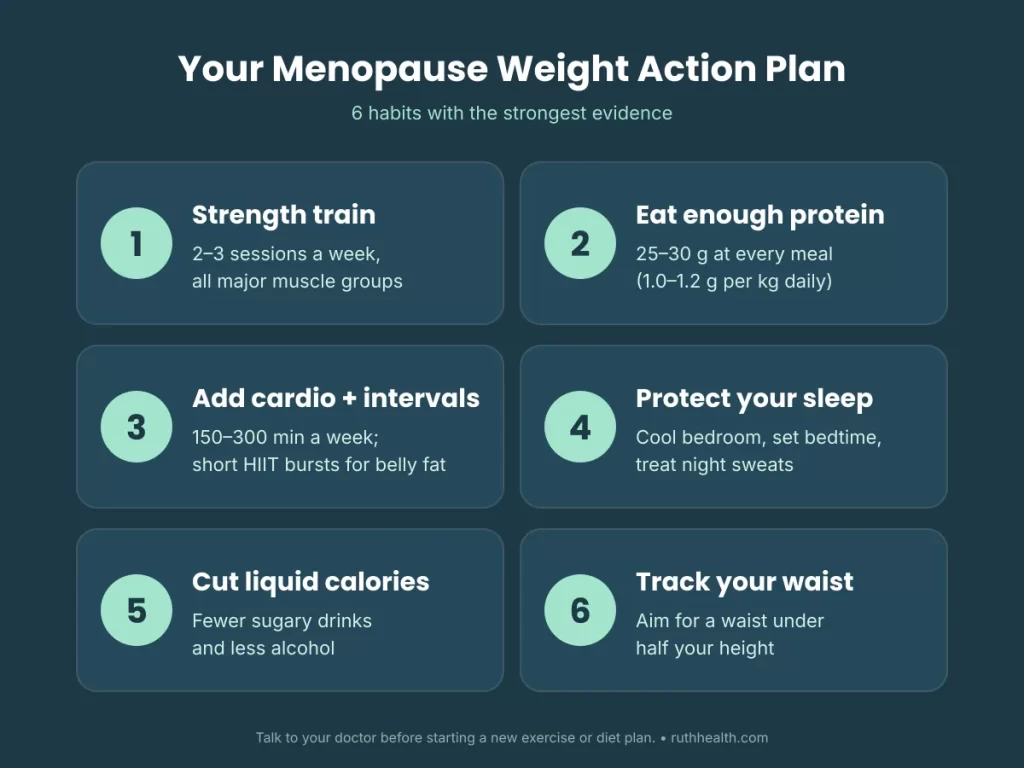
How to start: 2 to 3 sessions a week, working all major muscle groups (legs, hips, back, chest, arms, core). Squats, lunges, rows, push-ups and deadlifts with dumbbells or bands are ideal. Choose a weight that makes the last 2 to 3 reps of each set feel challenging.
2. Eat more protein, spread across the day
Protein helps you keep muscle and feel full for longer. Many older women don’t eat enough: research suggests about half of women over 71 fall short of their protein needs (review).
Expert groups including PROT-AGE and ESPEN recommend at least 1.0 to 1.2 grams of protein per kilogram of body weight per day for healthy older adults (Frontiers in Nutrition). Aiming for 25 to 30 grams per meal helps maximize muscle building.
| Your weight | Daily protein target (1.0 to 1.2 g/kg) | Per meal (3 meals) |
|---|---|---|
| 130 lb (59 kg) | 59 to 71 g | 20 to 24 g |
| 150 lb (68 kg) | 68 to 82 g | 23 to 27 g |
| 170 lb (77 kg) | 77 to 92 g | 26 to 31 g |
| 190 lb (86 kg) | 86 to 103 g | 29 to 34 g |
Good sources include eggs, Greek yogurt, cottage cheese, fish, chicken, lean meat, tofu, tempeh, lentils and beans. If you have kidney disease, check with your doctor before increasing protein.
3. Add cardio, including some higher-intensity work
Aerobic exercise is especially good at burning fat. Mayo Clinic recommends 150 to 300 minutes of moderate activity like brisk walking, or 75 to 150 minutes of vigorous activity, each week.
Short bursts of higher intensity may be particularly helpful for belly fat. In a 12-week trial in postmenopausal women, only the groups doing high-intensity interval training (HIIT) significantly reduced abdominal and visceral fat; steady moderate exercise did not. Try intervals like 30 seconds fast, 90 seconds easy, repeated 6 to 8 times, once you have a basic fitness base.
4. Build meals around fiber and whole foods
Choose mostly vegetables, fruit, whole grains, legumes, nuts and seeds. Fiber keeps you full, steadies blood sugar and feeds healthy gut bacteria. A simple plate rule: half vegetables, a quarter protein, a quarter whole-grain or starchy carbs, plus a little healthy fat.
5. Cut liquid calories and alcohol
Sugary drinks, sweetened coffees, juice and alcohol add calories without making you feel full. Alcohol also worsens hot flashes and sleep, so cutting back can help in more than one way.
6. Treat your sleep as a weight-loss tool
Because disrupted sleep reduces fat burning and increases appetite, improving sleep matters:
- Keep your bedroom cool (around 60 to 67°F / 16 to 19°C) and use breathable bedding.
- Keep a consistent sleep and wake time, even on weekends.
- Avoid alcohol, large meals and caffeine late in the day.
- If night sweats wake you often, talk to your doctor. Treating them can make every other step easier.
7. Manage stress on purpose
Regular walking, yoga, breathing exercises, time outdoors and social connection can all lower stress. Even 10 minutes a day helps. If anxiety or low mood is persistent, ask for professional support.
8. Move more throughout the day
Aim for regular movement on top of workouts: take the stairs, walk during phone calls, stand up every 30 to 60 minutes. Tracking daily steps is an easy way to notice and reverse a slow decline.
9. Track your waist, not just the scale
Since body composition can change while weight stays the same, measure your waist once a month. A shrinking waist and stronger muscles mean you’re on the right track, even if the scale barely moves.
10. Get checked and ask about medical options
If you’re doing the basics and still gaining, see your doctor. They can check your thyroid, blood sugar and medications, and discuss proven treatments:
- Hormone therapy (HT) is the most effective treatment for hot flashes and night sweats. The Menopause Society notes it may help reduce abdominal fat storage and preserve muscle, but the effect is modest, and experts say it is weight-neutral and should not be used for weight loss (AJMC).
- Prescription weight-loss medications such as GLP-1 drugs may be an option for some women. Early research presented at the Menopause Society’s 2026 meeting suggests women using hormone therapy may lose more weight on these drugs, though more research is needed (Healio).
A sample day of eating for menopause weight control
This example provides roughly 90 to 100 grams of protein and plenty of fiber. Adjust portions to your size and activity level.
| Meal | What to eat | Approx. protein |
|---|---|---|
| Breakfast | Greek yogurt (1 cup) with berries, chia seeds and a few walnuts | 25 g |
| Lunch | Large salad with grilled chicken or chickpeas, mixed vegetables, olive oil dressing and a slice of whole-grain bread | 30 g |
| Snack | 2 boiled eggs or a small portion of cottage cheese with cucumber | 12 to 14 g |
| Dinner | Baked salmon or tofu, roasted vegetables and half a cup of quinoa or brown rice | 28 to 30 g |
Does hormone therapy cause weight gain?
This is a common worry, but research does not show that menopausal hormone therapy causes weight gain. Experts describe it as weight-neutral. Some women notice mild bloating when they first start, which usually settles. If HT helps you sleep better by reducing night sweats, it may indirectly make weight management easier. Whether HT is right for you depends on your age, health history and symptoms, so discuss it with your doctor.
Can supplements help with menopause weight gain?
No supplement can replace strength training, protein and sleep, and many products make bigger promises than the evidence supports. A few nutrients matter during menopause for other reasons. Vitamin D and calcium support bone health, magnesium may help sleep, and protein powders can make it easier to hit your protein target.
If you’re considering a menopause or weight-loss supplement, read the label carefully, check for third-party testing, and talk to your doctor or pharmacist first, especially if you take other medications. You can see how we evaluate products in our 11-point review methodology and our menopause supplement reviews.
When to see a doctor
Make an appointment if:
- You’re gaining weight quickly (for example, more than 5 pounds in a month) without changes in diet or activity.
- You have other symptoms such as extreme tiredness, feeling cold, hair loss or constipation (possible thyroid problems).
- You notice swelling in your legs or belly, or shortness of breath.
- Your hot flashes, night sweats or mood changes are affecting your sleep or daily life.
- You’ve made consistent lifestyle changes for 3 months or more without any improvement.
Frequently asked questions
Is menopause weight gain permanent?
No. The rapid changes in body composition usually slow down about 2 years after your final period, and the weight can be lost with the same approach that works at any age, with extra emphasis on strength training and protein. It may take more patience than it did in your 30s.
Why am I gaining weight in perimenopause even though I eat less?
During late perimenopause you may be losing muscle and gaining fat at the same time, and your calorie needs may be falling. Poor sleep and stress can also affect hunger and fat storage. Eating less without strength training can lead to even more muscle loss, which makes the problem worse.
How long does menopause weight gain last?
Based on SWAN data, the fastest changes happen from about 2 years before to 2 years after your final period. After that, weight changes tend to follow general aging and lifestyle patterns.
What is the best exercise for menopause belly fat?
A combination works best. Strength training 2 to 3 times a week protects muscle, while aerobic exercise, including some high-intensity intervals, is most effective for reducing belly and visceral fat.
How many calories should I eat during menopause?
It depends on your size, activity and goals, so there’s no single number. Your needs may be around 100 to 200 calories a day lower than they were in your 30s. Rather than strict counting, focus on protein at each meal, plenty of vegetables, and fewer sugary drinks and snacks. A registered dietitian can give you a personal target.
Does intermittent fasting work for menopause weight loss?
It can help some women eat fewer calories, but it isn’t better than other approaches that reduce calories. If you try it, make sure you still get enough protein, and stop if it disrupts your sleep or energy.
The bottom line
Menopause weight gain is common, but it isn’t inevitable or permanent. Falling estrogen moves fat to your belly, muscle loss lowers your calorie needs, and night sweats and stress make everything harder. The window from about 2 years before to 2 years after your final period is when your body changes fastest, which makes it the best time to act.
Focus on what the research supports most strongly: lift weights 2 to 3 times a week, eat 25 to 30 grams of protein at each meal, add regular cardio, protect your sleep and cut back on liquid calories. If you’re doing all of this and still struggling, talk to your doctor about treating your symptoms and other medical options.
Want to go deeper? Read more in our menopause and perimenopause guides.
