
Nails that split, peel, chip or break no matter how carefully you treat them are frustrating. Brittle nails are especially common in women, and while they’re usually caused by everyday habits, they can sometimes point to a nutrient deficiency or health problem.
This guide explains the 10 most common causes of brittle nails, the signs that need a doctor’s attention, and practical ways to make your nails stronger. This guide explains everything you need to know about brittle nails.
Key takeaways
- Weak, splitting nails are very common in women, and become more common with age.
- The most common cause is repeated wetting and drying from handwashing, cleaning and dishes.
- Nail polish remover, gel manicures and harsh chemicals weaken nails.
- Low iron, thyroid problems and protein deficiency can also weaken nails.
- Moisturizing, wearing gloves for wet work and gentle nail care help most women. Nails take about 6 months to grow out fully.
What are brittle nails?
Brittle nails split, peel in layers, crack, or break easily. Doctors describe two main types:
- Onychoschizia: nails peel or split into layers at the tip.
- Onychorrhexis: nails develop vertical ridges and split lengthwise.
Nail brittleness is more common in women and become more common with age, as nails lose moisture and fats. A 2019 review in Dermatology and Therapy describes it as a frequent reason for dermatology visits and stresses treating the underlying cause whenever there is one.
10 common causes of brittle nails
1. Frequent wetting and drying
This is the most common cause. Washing hands, doing dishes and cleaning cause nails to swell with water and then shrink as they dry, which weakens them over time. Cleveland Clinic dermatologists point out that nails lose water faster than skin, so frequent handwashing and sanitizer dry them out.
2. Harsh chemicals
Cleaning products, detergents and hand sanitizers strip natural oils from nails.
3. Nail polish remover
Acetone-based removers are especially drying.
4. Gel and acrylic manicures
Removing gel polish and acrylics, plus filing the nail surface, can thin and weaken nails.
5. Aging
Nails naturally become drier and more brittle with age.
6. Iron deficiency
Low iron can make nails fragile and, in more severe cases, spoon-shaped nails (koilonychia). Low iron is common in women; read about why women are always tired.
7. Thyroid problems
An underactive thyroid can cause dry, fragile nails along with tiredness and feeling cold. Read about hypothyroidism symptoms in women.
8. Low protein or crash dieting
Nails are made of keratin, a protein. Very low-calorie or low-protein diets can weaken them.
9. Menopause
Lower estrogen can affect skin and nail moisture.
10. Skin and medical conditions
Psoriasis, lichen planus, fungal nail infections, and circulation problems can all affect nails.
Brittle nails and vitamins: what helps?
| Nutrient | Role in nails | Good food sources |
|---|---|---|
| Protein | Nails are made of keratin protein | Eggs, fish, chicken, beans, dairy |
| Iron | Supports healthy nail growth | Red meat, lentils, spinach, fortified cereals |
| Biotin | May strengthen nails in some people | Eggs, nuts, seeds, sweet potatoes |
| Zinc | Supports cell growth | Shellfish, meat, pumpkin seeds |
| Vitamin C | Helps make collagen and absorb iron | Citrus, peppers, berries |
Biotin is the most popular nail supplement. Some small studies suggest it may help brittle nails, but evidence is limited, and most people aren’t deficient. High-dose biotin can interfere with lab tests, including thyroid and heart tests, so tell your doctor if you take it. One small retrospective study found many patients reported stronger nails on biotin, but it had no control group, and dermatologists note that avoiding water and irritants plus moisturizing remain the mainstay of treatment.
If you have a true iron or other deficiency, correcting it can improve your nails. Ask your doctor for a blood test rather than guessing. See our hair and skin supplement reviews, scored with our 11-point audit.
How to strengthen brittle nails
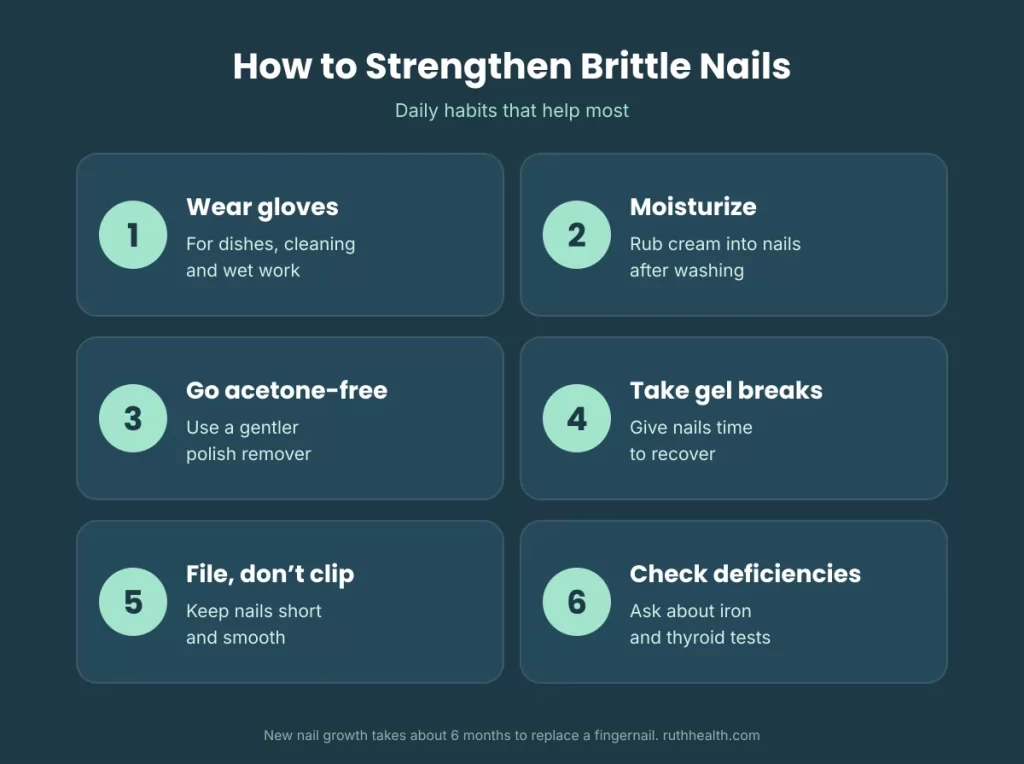
1. Wear gloves for dishes, cleaning and gardening.
2. Moisturize nails and cuticles several times a day, especially after washing. Look for creams with urea, lactic acid or lanolin.
3. Use acetone-free nail polish remover, and limit how often you use it.
4. Take breaks from gel and acrylic manicures.
5. Keep nails shorter, which makes them less likely to catch and break.
6. File in one direction with a fine-grit file, and round the edges.
7. Don’t use nails as tools to open cans or scrape labels.
8. Avoid biting or picking nails and cuticles.
9. Eat enough protein and a balanced diet.
10. Be patient: fingernails take about 6 months to grow out completely.
When to see a doctor
See your doctor or dermatologist if:
- Nails change color (yellow, green, white or dark streaks).
- Nails become thick, crumbly or separate from the nail bed.
- You see spoon-shaped nails or pitting.
- Nail changes come with fatigue, hair loss, feeling cold or weight changes.
- A dark stripe appears under a nail, especially if it’s new or changing.
- Nail changes don’t improve after a few months of good nail care.
Frequently asked questions about brittle nails
Why are my nails suddenly so brittle?
Common reasons include more handwashing, cleaning products, cold dry weather, gel manicure removal, or a recent illness or crash diet. Low iron or thyroid problems are also possible.
What deficiency causes brittle nails?
Iron deficiency is the most common nutritional cause. Low protein, zinc and, rarely, biotin can also contribute.
Does biotin help brittle nails?
It may help some people, but evidence is limited. It can also interfere with blood tests.
How long does it take to fix brittle nails?
You may see stronger new growth within a few months, but it takes about 6 months for a fingernail to grow out completely.
Are vertical ridges on nails a sign of deficiency?
Vertical ridges are common with age and usually harmless, but they can sometimes come with low iron or other problems.
The bottom line on brittle nails
Nail brittleness is common in women and most often caused by frequent wetting and drying, harsh chemicals, nail polish remover and gel manicures. Low iron, thyroid problems and poor nutrition can also play a role. Wearing gloves, moisturizing, gentle nail care and a balanced diet help most women, and a blood test can check for deficiencies if nails don’t improve.
Read more about collagen for skin and our nail health guides.
