
Feeling tired no matter how much you sleep, gaining weight without changing your habits, always cold, constipated, with dry skin and thinning hair? These everyday complaints are easy to blame on stress, age or a busy life. But together, they can be signs of an underactive thyroid. This guide explains everything you need to know about hypothyroidism symptoms.
Hypothyroidism is far more common in women than men, and because it develops slowly, it often goes unnoticed for years. This guide covers the 15 most common symptoms in women, what causes it, how it’s diagnosed and how it’s treated.
Key takeaways
- Hypothyroidism means your thyroid doesn’t make enough hormone, so many body functions slow down.
- About 4.6% of people in the US aged 12 and over have hypothyroidism, and it’s much more common in women.
- Hashimoto’s disease, an autoimmune condition, is the most common cause.
- Common symptoms include fatigue, weight gain, feeling cold, constipation, dry skin, hair thinning, low mood and heavy or irregular periods.
- It’s diagnosed with a simple TSH blood test and usually treated with a daily thyroid hormone pill.
What is hypothyroidism?
Your thyroid is a small butterfly-shaped gland at the front of your neck. It makes hormones (T4 and T3) that control how fast your body uses energy, affecting your heart rate, temperature, digestion, weight, mood and periods.
In hypothyroidism, the thyroid doesn’t make enough of these hormones. As the NIDDK explains, without enough thyroid hormone, many of the body’s functions slow down. About 4.6% of the US population aged 12 and older has hypothyroidism.
Why are women more affected?
Hashimoto’s disease, the main cause of hypothyroidism, affects more women than men. Thyroid problems can also be triggered by pregnancy: about 8% of women develop postpartum thyroiditis within a few months of giving birth, and for some, it becomes permanent.
What causes hypothyroidism?
According to the NIDDK, causes include:
- Hashimoto’s disease: the immune system attacks the thyroid. It’s the most common cause in the US.
- Thyroiditis: inflammation of the thyroid, including after pregnancy.
- Thyroid surgery or radiation treatment.
- Some medicines, such as lithium and certain cancer drugs.
- Too much or too little iodine (less common in the US).
- Pituitary gland problems (rare).
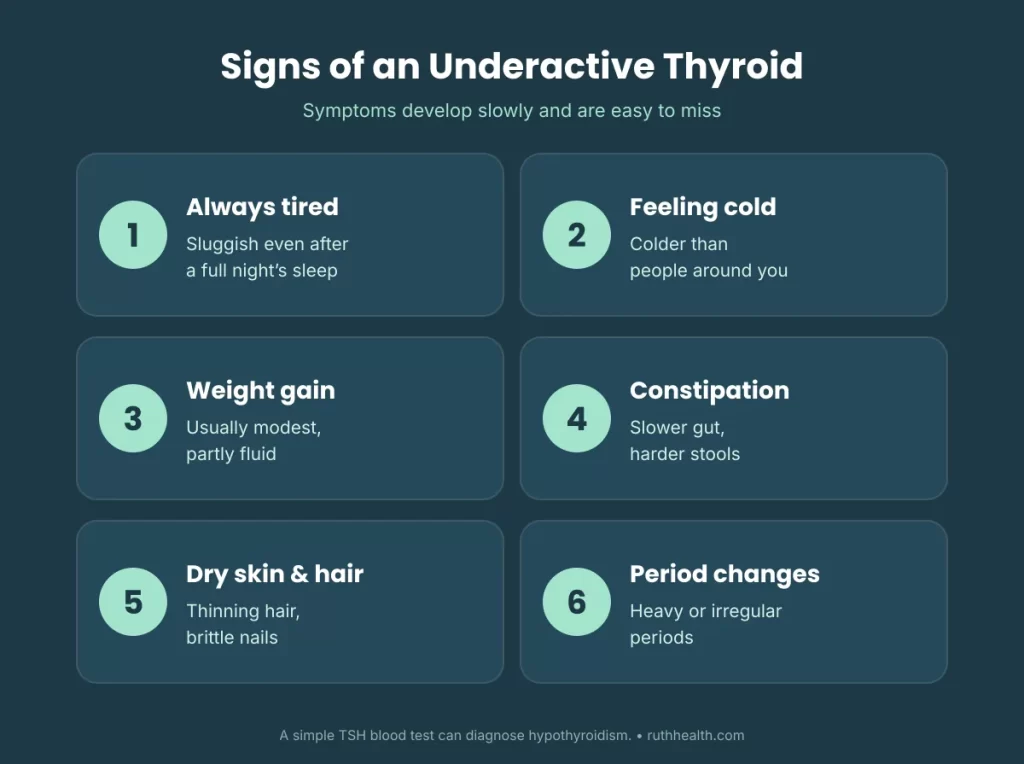
15 symptoms of hypothyroidism in women
Symptoms usually develop slowly, which is why many people don’t notice them for months or even years. Not everyone has all of them.
1. Fatigue
Feeling tired, sluggish or needing more sleep than usual is one of the most common symptoms. Read more about why women feel tired all the time.
2. Weight gain
A slower metabolism can lead to modest weight gain, often from fluid retention as well as fat. Hypothyroidism alone rarely causes large amounts of weight gain.
3. Feeling cold
Trouble tolerating cold, or always being colder than people around you.
4. Constipation
A slower gut means fewer, harder bowel movements.
5. Dry skin
Skin may feel rough, dry or itchy.
6. Thinning hair
Dry, coarse or thinning hair, including thinning of the outer third of the eyebrows. See our guide to hair loss in women.
7. Brittle nails
Nails may become weak and break easily.
8. Heavy or irregular periods
Hypothyroidism can cause heavy or irregular menstrual periods and fertility problems. See our guide to irregular periods.
9. Trouble getting pregnant
Low thyroid hormone can affect ovulation, so women with fertility problems are often tested.
10. Low mood or depression
Depression and feeling flat are common, and easy to mistake for a purely mental health problem.
11. Brain fog and poor memory
Slower thinking and difficulty concentrating.
12. Joint and muscle aches
Stiffness, aches and cramps, especially in the morning.
13. Slow heart rate
A heart rate slower than usual.
14. Puffy face and hoarse voice
Swelling around the eyes and face, and a deeper or hoarse voice.
15. Swelling in the neck (goiter)
With Hashimoto’s, the thyroid can enlarge, causing a swollen neck or a feeling of fullness in the throat.
Important: as the NIDDK notes, many of these symptoms, especially fatigue and weight gain, are common and don’t necessarily mean you have a thyroid problem. That’s why a blood test is essential.
Hypothyroidism vs. menopause
Hypothyroidism often appears in midlife, the same time as perimenopause. Both can cause fatigue, weight gain, low mood, brain fog and period changes. One key difference: hypothyroidism usually makes you feel cold, while menopause causes hot flashes. If you’re unsure, ask for a thyroid test. Read our guide to hot flashes.
How is hypothyroidism diagnosed?
Doctors can’t diagnose hypothyroidism from symptoms alone. The main test is:
| Test | What it shows |
|---|---|
| TSH (thyroid-stimulating hormone) | The first test. A high TSH usually means your thyroid is underactive |
| Free T4 | Confirms low thyroid hormone if TSH is high |
| Thyroid antibodies (TPO) | Shows if Hashimoto’s disease is the cause |
When thyroid hormone levels are low, the pituitary gland makes more TSH to push the thyroid harder, which is why a high TSH is the key sign.
Subclinical hypothyroidism means TSH is mildly high but T4 is normal. It may or may not need treatment depending on your symptoms, TSH level, age and whether you’re planning a pregnancy.
How is hypothyroidism treated?
Hypothyroidism is usually treated with levothyroxine, a daily pill that replaces the missing thyroid hormone. According to Harvard Health, it can be diagnosed with a blood test and treated with a pill.
Tips for taking it:
- Take it at the same time every day, usually on an empty stomach 30 to 60 minutes before breakfast.
- Take it 4 hours apart from calcium, iron, magnesium and some antacids, which block absorption.
- Get your TSH rechecked 6 to 8 weeks after starting or changing the dose.
- Tell your doctor if you’re pregnant or planning pregnancy, as your dose often needs to increase.
Most people feel better within a few weeks, though it can take a few months to get the dose right.
Why treatment matters
Untreated hypothyroidism can increase your risk of high cholesterol, high blood pressure and heart disease. It can also affect fertility and pregnancy health.
Can diet or supplements help?
No diet cures hypothyroidism, but eating a balanced diet supports your overall health. Be cautious with:
- Iodine and kelp supplements: too much iodine can worsen some thyroid conditions.
- Biotin: high doses can interfere with thyroid blood tests and give false results. Stop biotin a few days before testing (ask your doctor).
- “Thyroid support” supplements: some contain hidden thyroid hormone. Don’t use them instead of prescribed treatment.
When to see a doctor
Ask for a thyroid test if you have several of the symptoms above, especially if you:
- Have a family history of thyroid disease.
- Have another autoimmune condition (like type 1 diabetes or celiac disease).
- Recently had a baby.
- Are having trouble getting pregnant.
- Have high cholesterol.
Frequently asked questions about hypothyroidism symptoms
What are the first signs of thyroid problems in women?
Often fatigue, feeling cold, constipation, dry skin and changes in your periods. Symptoms usually come on slowly.
Can hypothyroidism cause weight gain?
Yes, usually a modest amount (often 5 to 10 pounds), partly from fluid. Large weight gain is usually due to other factors too.
Can hypothyroidism cause anxiety?
Hypothyroidism more often causes low mood and depression. Anxiety and a racing heart are more typical of an overactive thyroid (hyperthyroidism).
Is hypothyroidism permanent?
Hashimoto’s-related hypothyroidism is usually lifelong. Some types, like postpartum thyroiditis, can resolve on their own.
What TSH level is normal for women?
Most labs use a range of about 0.4 to 4.0 mIU/L, though ranges vary by lab, age and pregnancy. Your doctor will interpret your result.
The bottom line on hypothyroidism symptoms
Hypothyroidism is common in women and easy to miss because its symptoms, like fatigue, weight gain, feeling cold, constipation, dry skin, hair thinning and low mood, develop slowly and overlap with everyday life. A simple TSH blood test can diagnose it, and treatment with a daily pill usually works well.
If several of these symptoms sound familiar, ask your doctor for a thyroid test. Read more in our thyroid guides.
