A period that shows up early, late, not at all, or much heavier than usual can be worrying. Some variation from month to month is normal, but irregular periods can also be a sign that something in your body needs attention, from stress and weight changes to PCOS, thyroid problems or perimenopause.
This guide explains what counts as a normal cycle, the 10 most common causes of irregular periods, what to track, and when it’s time to see a doctor.
Key takeaways
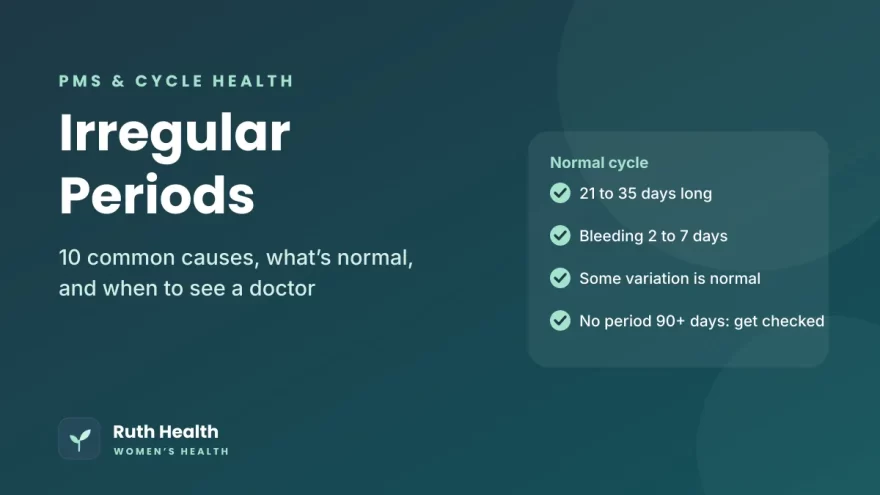
- A normal menstrual cycle lasts 21 to 35 days, with bleeding for 2 to 7 days.
- 14% to 25% of women have irregular menstrual cycles.
- Common causes include stress, weight changes, PCOS, thyroid problems, birth control, breastfeeding and perimenopause.
- Going 90 days or more without a period is considered abnormal unless you’re pregnant, breastfeeding or going through menopause.
- See a doctor for very heavy bleeding, bleeding between periods or after sex, or bleeding after menopause.
What’s a normal menstrual cycle?
Your cycle is counted from the first day of one period to the first day of the next. According to the NICHD, a normal cycle for most women ranges from 21 to 35 days. Cleveland Clinic notes the average is 29 days, and periods typically last 4 to 7 days.
It’s normal for your cycle to vary by a few days, and you don’t have to be able to predict it to the exact day for it to be considered normal.
What counts as an irregular period?
Your periods may be irregular if:
- They come fewer than 21 days or more than 35 days apart.
- You miss three or more periods in a row.
- Your cycle length varies by more than 20 days from one month to the next.
- Bleeding is much heavier or lighter than usual.
- Your period lasts longer than 7 days.
- You bleed or spot between periods or after sex.
| Medical term | What it means |
|---|---|
| Oligomenorrhea | Infrequent periods, more than 35 days apart |
| Polymenorrhea | Frequent periods, less than 21 days apart |
| Amenorrhea | No periods for 3 months or more (or never started by 15) |
| Menorrhagia | Heavy menstrual bleeding |
| Prolonged bleeding | Bleeding longer than 8 days regularly |
| Intermenstrual bleeding | Bleeding or spotting between periods |
According to the NICHD, 14% to 25% of women have irregular menstrual cycles.
10 common causes of irregular periods
1. Pregnancy
A missed period is often the first sign. If there’s any chance you could be pregnant, take a test.
2. Stress
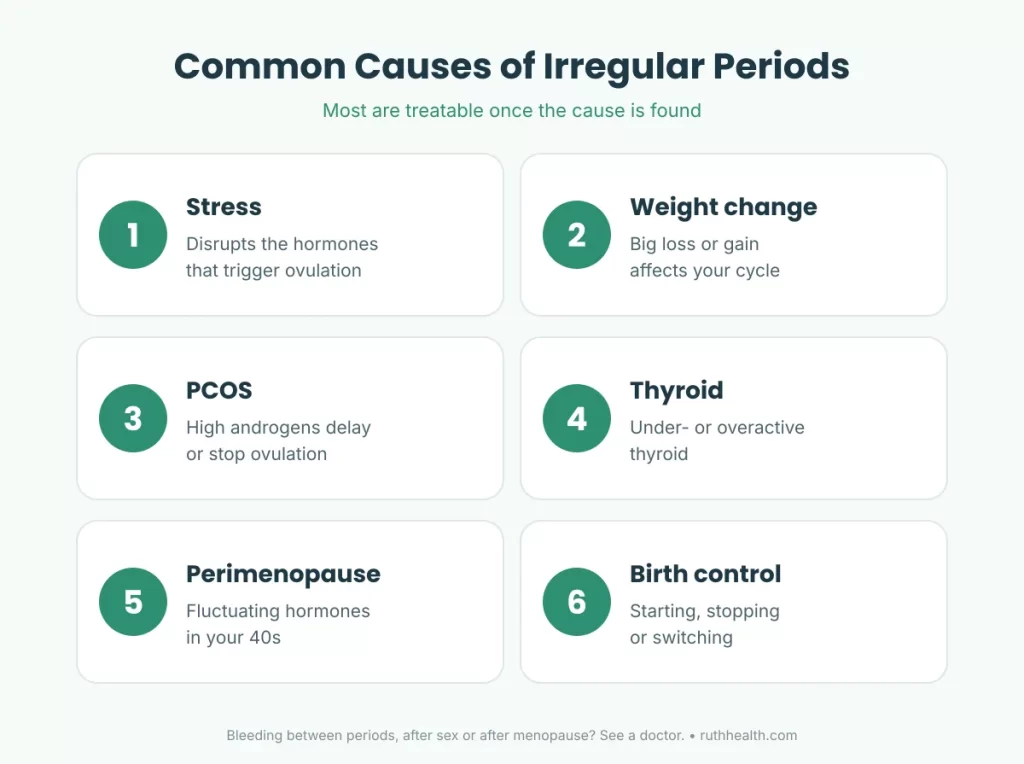
High stress can affect the hormones that trigger ovulation, delaying or stopping your period.
3. Weight changes
Significant weight loss, weight gain or very low body fat can disrupt your cycle. Significant weight loss or gain is a common cause of absent or irregular periods.
4. Over-exercising or under-eating
Intense training without enough food (low energy availability) can stop periods altogether. This can also weaken your bones.
5. Polycystic ovary syndrome (PCOS)
In PCOS, the ovaries make high levels of androgens, which prevent or delay ovulation. It’s one of the most common causes of irregular periods. Read our guide to PCOS symptoms.
6. Thyroid problems
Both underactive and overactive thyroid can cause irregular periods. Read about hypothyroidism symptoms in women.
7. Perimenopause
In your 40s, hormone levels fluctuate as you approach menopause, causing cycles that are shorter, longer, heavier or lighter. Oligomenorrhea is common in perimenopausal women due to fluctuating hormones.
8. Hormonal birth control and IUDs
Starting, stopping or switching hormonal contraception often changes your bleeding pattern, especially in the first few months.
9. Breastfeeding
Breastfeeding hormones can delay the return of periods for months.
10. Other medical conditions
Including high prolactin, primary ovarian insufficiency (ovaries stopping before age 40), uterine fibroids, polyps, endometriosis, pelvic infections, diabetes, and, rarely, uterine or ovarian cancer.
Irregular periods by age
- Teens: irregular cycles are common in the first few years after periods start. But periods still very irregular 3 years after starting deserve a check.
- 20s and 30s: irregular periods are more likely to signal PCOS, thyroid problems, stress, weight changes or contraception effects.
- 40s: perimenopause is a common cause, but heavy or very frequent bleeding should still be checked.
- After menopause: any bleeding after 12 months without a period needs prompt medical attention.
What to track
Keeping a record for 3 months helps you and your doctor spot patterns. Note:
- The first day of each period and how many days you bleed.
- How heavy the flow is (number of pads or tampons, any clots).
- Spotting between periods.
- Pain, mood changes and other symptoms.
- Stress, illness, travel or big changes in diet or exercise.
Period tracking apps make this easy.
How irregular periods are diagnosed
Your doctor will ask about your cycle history and may order:
- A pregnancy test.
- Blood tests: TSH (thyroid), prolactin, FSH, LH, estradiol, testosterone, and a full blood count if bleeding is heavy.
- A pelvic ultrasound to look for fibroids, polyps or polycystic ovaries.
- Other tests depending on your symptoms and age.
Treatment for irregular periods
Treatment depends on the cause:
- Lifestyle changes: managing stress, reaching a healthy weight and eating enough if you exercise a lot.
- Hormonal birth control: regulates cycles and protects the womb lining, often used for PCOS.
- Thyroid medication: if hypothyroidism is the cause.
- Treating PCOS: diet, exercise, metformin or other medicines. See our PCOS diet guide.
- Medicine for heavy bleeding: such as tranexamic acid, hormonal IUDs or other treatments.
- Procedures: to remove fibroids or polyps if needed.
Why irregular periods matter
Beyond being inconvenient, long-term irregular periods can mean:
- Difficulty getting pregnant, because you’re not ovulating regularly.
- A thicker womb lining: going many months without a period can raise the risk of endometrial problems.
- Iron deficiency from heavy bleeding, causing tiredness.
- Bone loss if periods stop due to low estrogen.
When to see a doctor
Make an appointment if:
- You’ve had no period for 3 months (and you’re not pregnant, breastfeeding or in menopause).
- Your cycles are consistently shorter than 21 days or longer than 35 days.
- You’re soaking through one or more pads or tampons every hour for several hours.
- You bleed between periods, after sex or after menopause.
- Your periods are very painful or you have fever or unusual discharge.
- You’ve been trying to get pregnant for 12 months (or 6 months if over 35).
Seek urgent care for very heavy bleeding with dizziness or fainting, or severe pelvic pain.
Frequently asked questions
Is it normal to have an irregular period once?
Yes. An occasional early, late or different period is common, especially with stress, illness or travel.
How late can a period be before it’s a concern?
If your period is more than a week late and you could be pregnant, take a test. If you’ve missed three periods in a row, see a doctor.
Can stress really stop your period?
Yes. Stress can disrupt the hormones that control ovulation and delay or stop periods.
Can irregular periods affect fertility?
Yes, if they mean you’re not ovulating regularly. Many causes are treatable, so talk to your doctor if you’re trying to conceive.
Are irregular periods a sign of perimenopause?
They can be, especially in your 40s. Changes in cycle length and flow are often the first sign of perimenopause.
The bottom line
A normal menstrual cycle lasts 21 to 35 days, and some variation is normal. But cycles that are consistently too short or too long, missed periods, very heavy bleeding or bleeding between periods can signal causes like PCOS, thyroid problems, stress, weight changes or perimenopause. Track your cycle for a few months and see your doctor if something doesn’t feel right.
Read more in our PMS and cycle health guides.