
If you could once lose a few pounds by skipping dessert for a week, losing weight after 40 can feel like a different game. You’re eating the same, maybe even less, yet the scale won’t budge, and the weight seems to settle around your middle.
You’re not imagining it. Muscle loss, hormone changes, sleep and a busier life all make weight loss harder after 40. But it is still very possible. This guide explains what changes, and 12 steps that work for women in their 40s and beyond. This guide explains everything you need to know about weight loss after 40.
Key takeaways
- After 40, women tend to lose muscle and gain fat, which lowers the calories you burn.
- Perimenopause shifts fat toward the belly, and the SWAN study found fat gain roughly doubles around the menopause transition.
- Strength training and enough protein are the two most important changes.
- Aim for 1.0 to 1.2 grams of protein per kg of body weight a day, with 25 to 30 grams per meal.
- Sleep, stress, alcohol and daily movement matter more than ever.
Why is it harder to lose weight after 40?
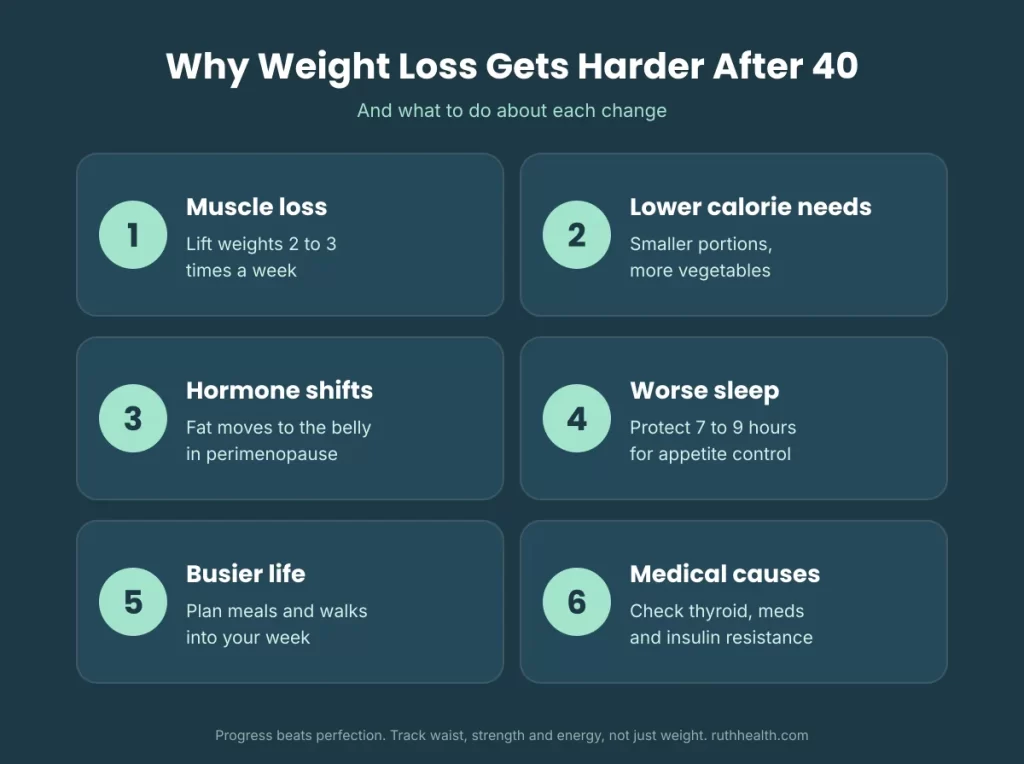
You’re losing muscle
From around your 40s, muscle mass gradually declines, and this speeds up during the menopause transition. The SWAN study found that about 2 years before the final period, the rate of fat gain doubled and lean mass began to decline. Less muscle means fewer calories burned at rest.
Your calorie needs are lower
A study in the Annals of Internal Medicine found women who went through menopause lost more fat-free mass and burned about 100 fewer calories a day at rest than women who hadn’t. A 2023 study suggests age itself plays a big role too. Either way, eating the same as you did at 30 can lead to slow weight gain.
Hormones move fat to your belly
Falling and fluctuating estrogen in perimenopause shifts fat storage from hips and thighs to the abdomen. Read more in our guide to menopause weight gain.
Sleep gets worse
Night sweats, stress and waking at 3 a.m. are common in your 40s. Poor sleep increases hunger and cravings and reduces fat burning.
Life is busier
Career, children, ageing parents and less time for yourself often mean less movement and more convenience food.
12 steps to lose weight after 40
1. Make strength training your priority
Lift weights or do resistance exercises 2 to 3 times a week, covering legs, hips, back, chest, arms and core. A meta-analysis of 101 studies found exercise training in postmenopausal women increased muscle and reduced fat mass, waist size and visceral fat.
2. Eat more protein
Expert groups recommend at least 1.0 to 1.2 g of protein per kg of body weight daily for older adults to protect muscle. Spreading 25 to 30 grams per meal helps maximize muscle building.
| Your weight | Daily protein | Per meal |
|---|---|---|
| 140 lb (64 kg) | 64 to 77 g | 21 to 26 g |
| 160 lb (73 kg) | 73 to 88 g | 24 to 29 g |
| 180 lb (82 kg) | 82 to 98 g | 27 to 33 g |
3. Create a modest calorie deficit
Cut around 300 to 500 calories a day rather than crash dieting. Severe restriction speeds up muscle loss.
4. Fill half your plate with vegetables
Vegetables add volume and fiber for very few calories, keeping you full.
5. Choose smart carbs
Swap refined carbs for whole grains, beans, lentils and starchy vegetables, in sensible portions.
6. Cut liquid calories
Sugary drinks, juice, fancy coffees and alcohol add up fast. Alcohol also disrupts sleep and worsens hot flashes.
7. Walk more every day
Daily steps add up. Aim to gradually increase your step count and take a short walk after meals to help control blood sugar.
8. Add some intervals
Short bursts of higher intensity may be especially helpful for belly fat. A trial in postmenopausal women found HIIT reduced abdominal and visceral fat more than steady moderate exercise.
9. Protect your sleep
Aim for 7 to 9 hours. Keep a regular schedule and a cool bedroom. If night sweats wake you, see our guide to night sweats in women.
10. Manage stress
Chronic stress raises cortisol and drives cravings. Find a daily stress-relief habit.
11. Check for medical causes
An underactive thyroid, insulin resistance, PCOS and some medicines can make weight loss harder. Read about hypothyroidism symptoms.
12. Track progress beyond the scale
Measure your waist monthly and notice strength, energy and how clothes fit. Building muscle while losing fat can mean the scale moves slowly even when you’re making real progress.
A sample day of eating
| Meal | Example |
|---|---|
| Breakfast | Greek yogurt with berries, oats and a few nuts |
| Lunch | Large salad with chicken or chickpeas, olive oil and whole-grain bread |
| Snack | Boiled eggs or cottage cheese with vegetables |
| Dinner | Salmon or tofu, roasted vegetables and a small portion of quinoa |
What about medications?
For women with obesity or weight-related health conditions, prescription medicines such as GLP-1 drugs may be an option alongside lifestyle changes. Talk to your doctor about whether they’re right for you.
Do weight loss supplements help after 40?
Most have weak evidence, and some contain stimulants. Protein powder can be useful for hitting protein targets. See our weight loss supplement reviews, scored with our 11-point audit.
Frequently asked questions about weight loss after 40
Why can’t I lose weight after 40 even though I eat less?
Muscle loss, lower calorie needs, hormone changes, poor sleep and stress all play a role. Eating less without strength training can lead to more muscle loss, which makes things harder.
What is the best exercise for women over 40 to lose weight?
A combination of strength training 2 to 3 times a week, regular cardio and some interval training.
How much weight can a woman over 40 lose in a month?
A healthy, sustainable rate is about 2 to 4 kg (4 to 8 pounds) a month, though it’s often slower. Steady progress lasts longer.
Does intermittent fasting work after 40?
It can help some women eat less, but it’s not better than other ways of reducing calories. Make sure you still get enough protein.
Is it harder to lose weight in perimenopause?
Yes, hormone changes, sleep disruption and muscle loss make it harder, but strength training, protein and good sleep make a big difference.
The bottom line on weight loss after 40
Losing weight after 40 is harder because of muscle loss, lower calorie needs, hormone changes and poorer sleep, but it’s absolutely possible. Prioritize strength training and protein, eat mostly whole foods with plenty of vegetables, cut liquid calories, move more every day, sleep well and manage stress. Be patient and measure progress by your waist and strength, not just the scale.
Read more in our weight loss after 40 guides.
